Global existence for consensus-based kinetic models for image segmentation
A. Agosti, P. Colli, E. Rocca, M. Zanella
Preprint arXiv, 2026
In this article, we analyze a recently introduced kinetic model based on Hegselmann-Krause-type interaction dynamics describing consensus-based image segmentation in the mean-field regime, where particle density depends on spatial coordinates and the normalized gray level (feature) value. The model is formulated as an evolutive nonlocal partial differential equation featuring a non-local spatial drift term involving a bounded confidence interaction kernel, depending on spatial and feature proximity, and a spatial diffusion term degenerating in the feature variable representing aleatoric uncertainties. Establishing well-posedness on a bounded domain, essential for practical image processing, presents significant analytical challenges: the lack of uniform control of space derivatives due to kernels with jump discontinuities and degenerate spatial diffusion, complex non-standard boundary terms under homogeneous Neumann conditions, and a lack of compactness arising from the absence of derivatives with respect to the feature variable. To address these difficulties, we introduce a three-level regularization scheme. Specifically, we smooth the interaction kernel, apply structural boundary regularization to the non-local interaction term to simplify boundary conditions, and incorporate artificial diffusion in spatial and feature variables to resolve degeneracy. We prove the well-posedness and regularity of the regularized system via a finite difference scheme and study the asymptotic limit as regularization parameters vanish, proving the existence of weak/distributional solutions of the original model. This approach advances the mathematical theory of kinetic models for image segmentation by extending the framework of distributional solutions to bounded domains and non-smooth interaction kernels with jump discontinuities.
Collective impact of opinion formation on agent-based epidemic dynamics
A. Bondesan, R. Vecchio, C. Barbati, J. Franceschi, A. Odone, M. Zanella
Preprint arXiv, 2026
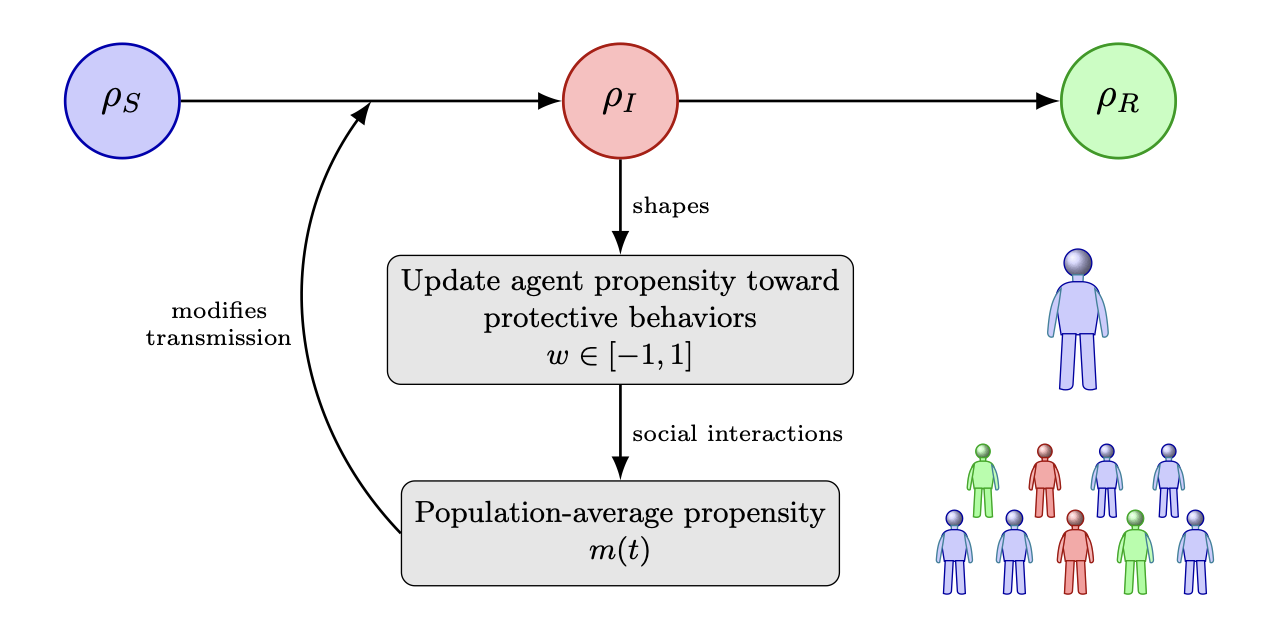 Epidemic spread and collective opinion formation are tightly coupled processes: individual beliefs about the severity of an outbreak and the value of protective measures shape behavior, while the evolving epidemic itself reshapes public sentiment through risk perception. We propose an agent-based framework that couples opinion dynamics with a compartmental epidemic model, in which each agent carries both a health status and a continuous opinion variable describing adherence to protective measures. Opinion evolution is driven by binary interactions among agents and by an exogenous background field that reflects the current state of the epidemic, while the disease transmission rate depends explicitly on the opinions of interacting agents. Using methods of statistical mechanics, we characterize the resulting macroscopic system for the compartmental mass fractions and mean opinions in both far-from-equilibrium and close-to-equilibrium regimes. The calibration shows that incorporating behavioral opinion dynamics substantially improves the interpretation of epidemic evolution. In particular, the inferred risk perception function evolves consistently with the observed epidemic burden, indicating that behavioral adaptation can explain part of the temporal variation that would otherwise be absorbed into time-dependent transmission parameters. Our results illustrate how integrating opinion heterogeneity in kinetic epidemic models offers quantitative insights into the feedback between behavior and disease spread.
Multi-fidelity methods for kinetic models of epidemic dynamics with uncertain contact structure
L. Liu, A. Medaglia, H. Xie, M. Zanella
Computer Methods in Applied Mechanics and Engineering, in press. (Preprint arXiv)
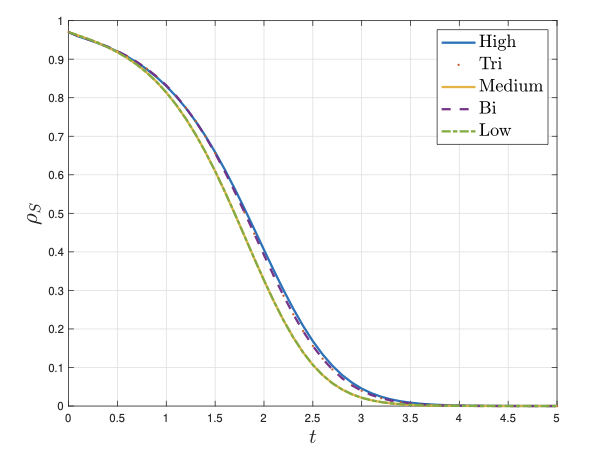 In this work, we develop a multi-fidelity strategy for kinetic models in epidemiology with uncertain contact dynamics. Assessing and controlling the population-level effects of contact dynamics requires the development of models for understanding observable effects of heterogeneous contact structures, whose formation depends on complex social phenomena. These can be captured taking into account high-dimensional uncertain quantities. The proposed approach combines high-fidelity kinetic solvers with a hierarchy of low-fidelity surrogates, including reduced macroscopic models and coarse kinetic descriptions, remaining applicable even in regimes where a macroscopic closure is unavailable. This hierarchical framework identifies representative parameter samples and reconstructs full solutions via projection-based techniques, enabling efficient uncertainty propagation while drastically reducing computational cost. Numerical experiments in high-dimensional stochastic settings demonstrate that accurate statistical estimates of epidemic observables can be obtained with significantly reduced computational costs compared to standard approaches.
A Multiscale Kinetic Framework for Image Segmentation: From Particle Systems to Continuum Models
H. Tettamanti, G. Guicciardi, M. Zanella
Preprint arXiv, 2026
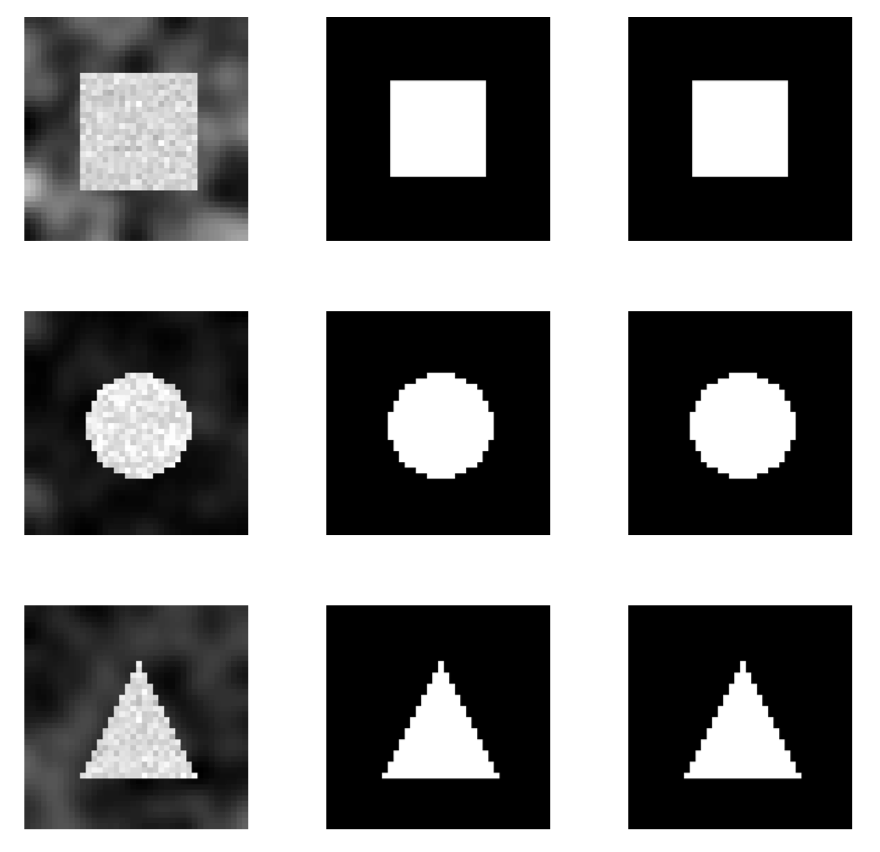 In this work, we present a multiscale kinetic framework for consensus-based image segmentation. By interpreting an image as a system of interacting particles, each pixel is characterised by its spatial position and an internal feature encoding color information.
We introduce a coupled interaction scheme governing the evolution of particles in both position and feature spaces, from which we derive a kinetic formulation for the particle density in the space-feature domain combining transport, aggregation, and diffusion effects. Furthermore, through a suitable scaling, we obtain a first-order macroscopic model describing the evolution of the fraction of pixels carrying information on the fraction of pixels having a certain feature. Based on this reduced-complexity model, we present a data-oriented approach where we make use of particle-based optimisation techniques for the accurate segmentation of images. Numerical tests show the effectiveness of the proposed framework and its robustness under different noise conditions.
In this work, we present a multiscale kinetic framework for consensus-based image segmentation. By interpreting an image as a system of interacting particles, each pixel is characterised by its spatial position and an internal feature encoding color information.
We introduce a coupled interaction scheme governing the evolution of particles in both position and feature spaces, from which we derive a kinetic formulation for the particle density in the space-feature domain combining transport, aggregation, and diffusion effects. Furthermore, through a suitable scaling, we obtain a first-order macroscopic model describing the evolution of the fraction of pixels carrying information on the fraction of pixels having a certain feature. Based on this reduced-complexity model, we present a data-oriented approach where we make use of particle-based optimisation techniques for the accurate segmentation of images. Numerical tests show the effectiveness of the proposed framework and its robustness under different noise conditions.
Kinetic SIS opinion-driven models with asymmetric awareness feedback: macroscopic limit and polarization
J. P. Pinasco, N. Saintier, H. Tettamanti, M. Zanella
Chaos, Solitons & Fractals, 210(2): 118686, 2026. (Preprint arXiv)
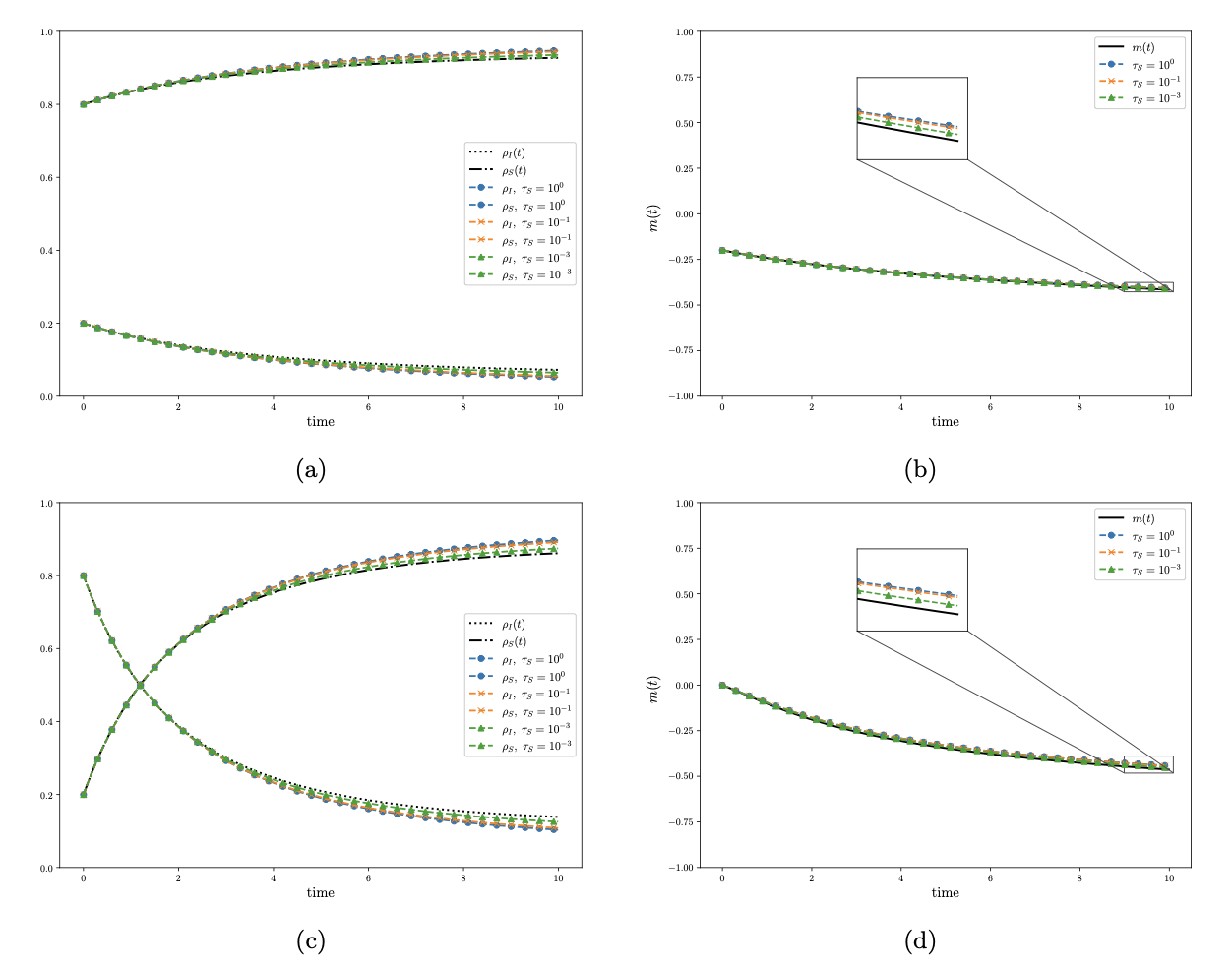 We study a kinetic multi-agent framework coupling opinion dynamics with epidemic spreading, where individual social behaviour both affects and is affected by disease transmission. Each agent is characterised by an epidemiological state and a continuous opinion variable measuring compliance with non-pharmaceutical interventions. The key mechanism of the model is an asymmetric opinion update driven by epidemic encounters: infection events induce more cautious attitudes, while failed transmissions push individuals toward more extreme opinions. We focus on a prototypical SIS setting, for which we derive a macroscopic kinetic description and, in a fast social-interaction regime, a reduced system of differential equations capturing the feedback between epidemic prevalence and opinion evolution. Convergence of the reduced model is rigorously quantified through a modified Wasserstein distance. Numerical simulations highlight how infection-induced awareness and non-infection-driven extremization jointly shape collective epidemic-opinion dynamics.
Supercritical mass and condensation in Fokker-Planck equations for consensus formation
M. Caloi, M. Zanella
Ricerche di Matematica, in press. (Preprint arXiv)
T. Lorenzi, H. Tettamanti, M. Zanella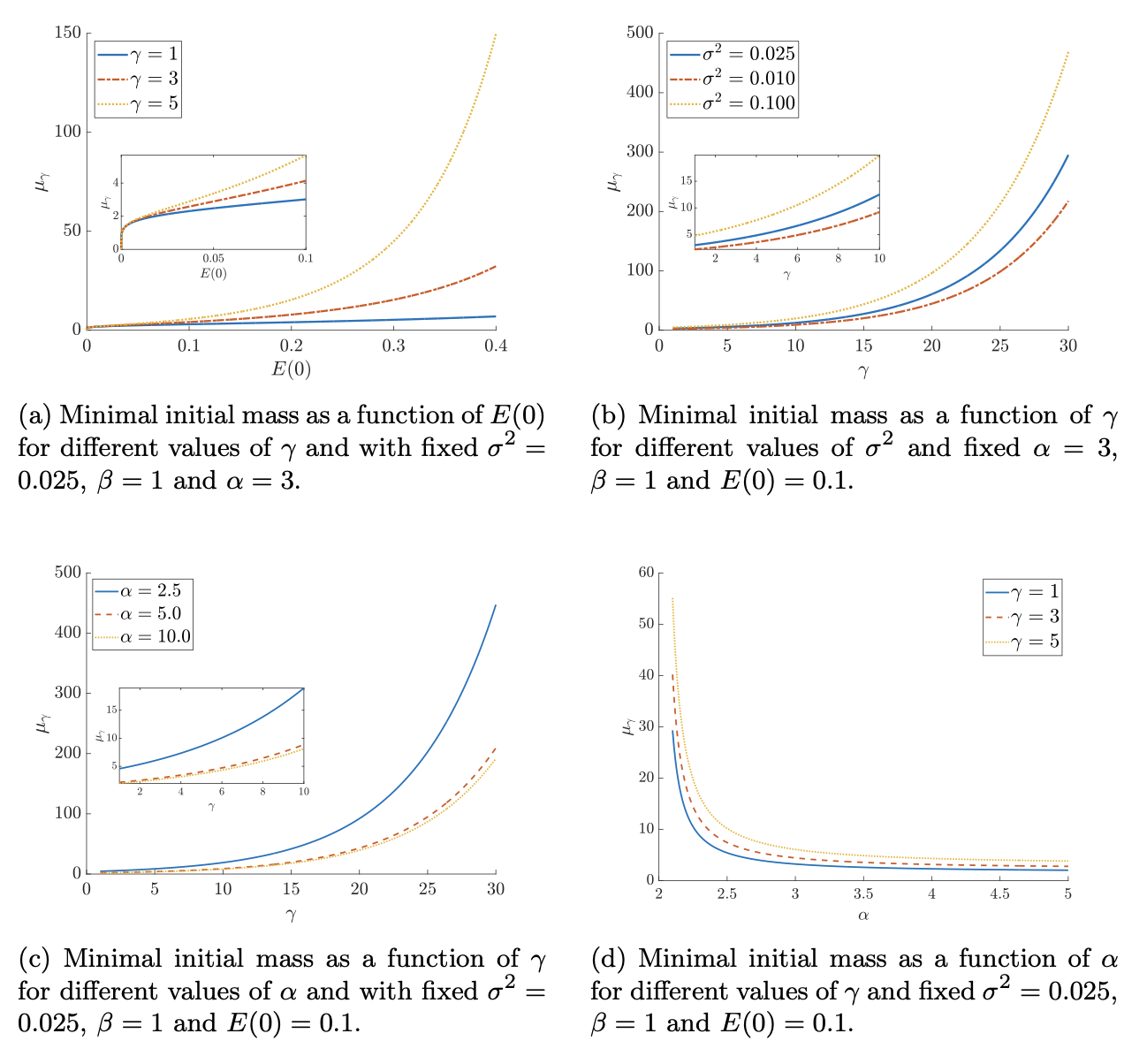 Inspired by recently developed Fokker–Planck models for Bose–Einstein statistics, we study a consensus formation model with condensation effects driven by a polynomial diffusion coefficient vanishing at the domain boundaries. For the underlying kinetic model, given by a nonlinear Fokker–Planck equation with superlinear drift, it was shown that if the initial mass exceeds a critical threshold, the solution may exhibit finite-time concentration in certain parameter regimes. Here, we show that this supercritical mass phenomenon persists for a broader class of diffusion functions and provide estimates of the critical mass required to induce finite-time loss of regularity.
Kinetic and mean-field modeling of muscular dystrophies
Studies in Applied Mathematics, 157(4): e70316, 2026.
(Preprint arXiv)
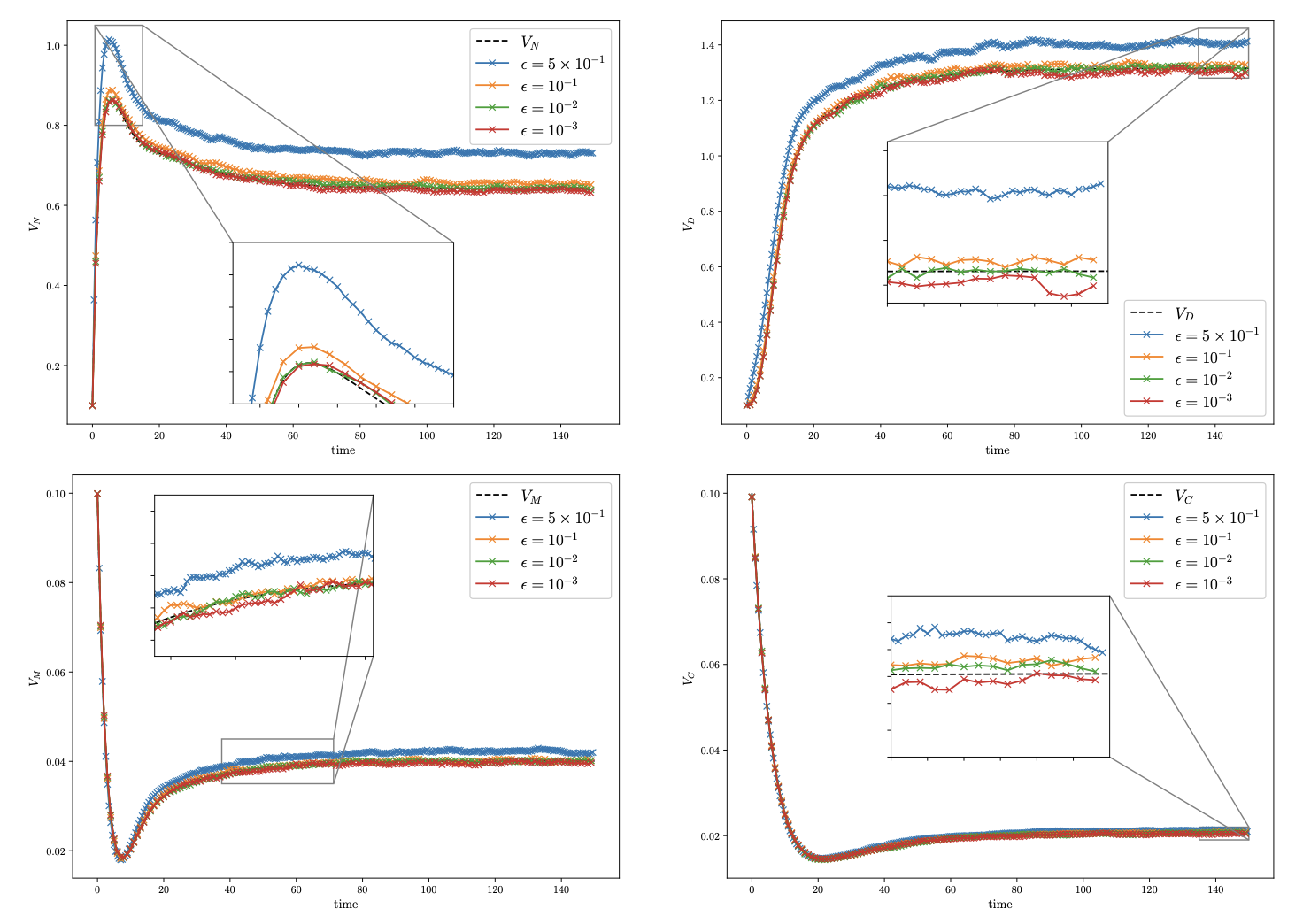 We present a new class of models for assessing the cell dynamics characterising muscular dystrophies. The proposed approach comprises a system of integro-differential equations for the statistical distributions over a large patient cohort, of the densities of muscle fibers and immune cells implicated in muscle inflammation, degeneration, and regeneration, which underpin disease development. Considering an appropriately scaled version of this model, we formally derive, as the corresponding mean-field limit, a system of Fokker-Planck equations, from which we subsequently derive, as a macroscopic model counterpart, a system of differential equations for the mean densities of muscle and immune cells in the cohort of patients and the related variances. Then, we study long-time asymptotics for the mean-field model by determining the quasi-equilibrium cell distribution functions, which are in the form of probability density functions of inverse Gamma distributions, and proving the long-time convergence to such quasi-equilibrium distributions. The analytical results obtained are illustrated by means of a sample of results of numerical simulations. The modeling approach presented here has the potential to offer new insights into the balance between degeneration and regeneration mechanisms in the progression of muscular dystrophies, and provides a basis for future extensions, including the modeling of therapeutic interventions.
Next Trips
- Conference "A Journey Across Kinetic Theory and Numerical Methods" (website), University of Ferrara, September 7-11, 2026
- Conference “Advances in Ordered Fluids and Alignment Phenomena: Modeling, Analysis, and Numerical Methods” (website), September 14-17, 2026, Pavia.
- Conference DATAHyKing (website), September 21-25, 2026, Sapienza University, Rome.
- Research visit University della Svizzera Italiana (USI), Research Group of Prof. Michael Multerer, November 2026.
Recent Articles
- Multi-fidelity methods for kinetic models of epidemic dynamics with uncertain contact structure June 25, 2026
- A Multiscale Kinetic Framework for Image Segmentation: From Particle Systems to Continuum Models June 2, 2026
- Kinetic SIS opinion-driven models with asymmetric awareness feedback: macroscopic limit and polarization April 1, 2026
- Supercritical mass and condensation in Fokker-Planck equations for consensus formation February 6, 2026
- Kinetic and mean-field modeling of muscular dystrophies November 20, 2025
Other Commitments
 International Center of Advanced Computing for Medicine